

In my previous blog post I talked about doing a Pinterest profile audit, and I’m ashamed to only now be getting to this follow up blog post. It’s just that this blog is low priority for me; I try to focus more on my other sites.
Better late than never, though. Let’s chat quickly about Step 1, which is to organize my Pinterest boards. This task involves conducting an audit of one’s board names, identifying inactive boards, and merging or archiving them if needed. Here are my insights:
What I Was Actually Auditing
Let’s lay out what I’m mainly evaluated my boards against below:
- Board names. Are my board titles keyword focused or are there a few with vague/irrelevant names?
- Activity. Are there boards I haven’t pinned to in a long time? 3 months is the cutoff for me.
- Redundancy. Are there boards that overlap so much with another board that there’s no real, objective reason for them to be separate?
Once I identified an issue with my boards, I wrote down the best solution for my content and strategy context.
Board Titles Audit
I’m quite happy with my board titles as I think they’re keyword dense and relevant, but still make sense to an actual reader. That said, one common trap I see a lot is giving boards quirky or too broad titles. So something like “Outfit Inspo” might actually be a keyword people search for often, but it can be too broad to be useful.
Don’t rename anything just yet as we’ll go through titles and descriptions in step 2 of the audit which will be a separate blog post. For now, just flag the board titles you’d like to work on. These are those that sound feel vague, too broad, or not relevant.
Activity Audit
My biggest issue in this audit was board inactivity. I used a three month cutoff to define ‘inactive’. Here’s where I found the biggest issue. My cutoff for what counts as “inactive” is three months. If I haven’t pinned to a board in over three months, it goes into this part of the audit, with a caveat for seasonal boards (more on that below).
Inactive boards are like dead weight when it comes to Pinterest. You really want to do something about them. Here’s how I sorted through them.

Boards I Archived
I chose to archive boards for which I’m just not creating content anymore. Over time my content clusters have become more defined and there’s no point in having these boards on my profile. I’ll get into content more in the next section, but the short version is: if a board no longer matches what I’m creating at present, I will archive the board it.
Do not jump to deletion, instead, archive. Archived boards can always be restored if your content strategy changes, unlike deleted boards.
Boards I Just Forgot About
Then was another category of inactive boards. These contained topics I’d just forgotten about but still am interested in creating content for. For these, I made a note to be more intentional about pinning to them again, even if that’s just once a month.
Seasonal Boards
Lastly, there were seasonal boards, like my Christmas and Thanksgiving boards. These can look inactive for most of the year, but that’s expected, so I’m leaving them as is rather than archiving. In the meantime, I’ll still pin a few things from other creators every so often, just to keep sending Pinterest a signal that the board is still relevant.
Content Audit
In this part of the audit, I examined my content clusters. Two questions guided this part:
- Do I have a content gap? That is, do I regularly create content that doesn’t have a designated board to live in?
- Do I have the opposite problem where I too many boards for the amount of content I create and the topics I address?
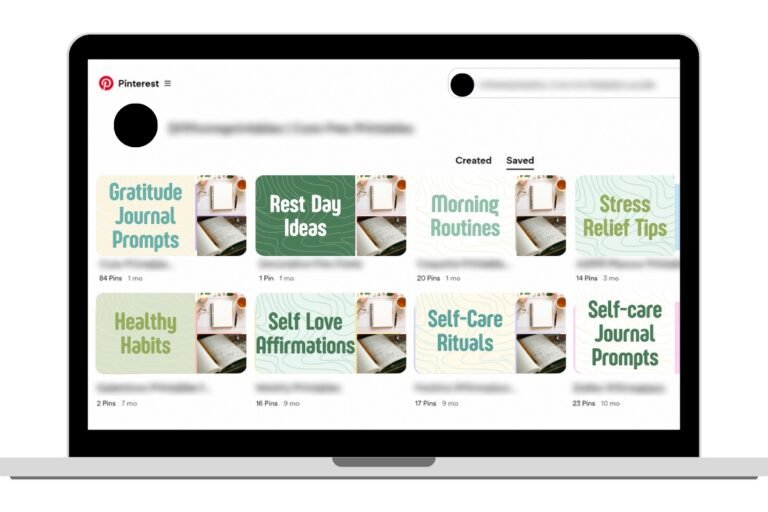
For me, it was mostly the second one. This is where the problem of topic redundancy and granularity come in. I found that I had such similar titled boards and that there was no objective reason for them to be separate. For example, I had four boards for affirmation cards, with slight title variations I created to get more granular for search. It’s important to note that none of these boards had a good amount of pins. In this case, I have made the decision to merge all four into one board (I’m yet to do this). I simply don’t produce enough affirmation content to have four boards on the topic.
Let’s give another example, this one made up. Say you have two boards, “Easy Healthy Vegan Recipes” and “Quick Vegan Dinner Recipes.” They’re related enough that you could reasonably pin the same content to either one, but you might notice the same topic on one board consistently outperforms the other. Here, instead of merging boards, it’s worth testing first. Try running a test where you pause posting to the weaker board for a stretch and watch what happens. I have a suspicion that sometimes we get too granular with board names without them actually being beneficial. The call on whether to merge boards it completely yours. Diligently study your analytics and performance.
That’s it for Step 1. Next up: SEO Optimization, working keywords into board titles and descriptions.
Until next time, happy pinning!

One Comment